UPSC Syllabus 2026-2027: A Comprehensive Roadmap for IAS Aspirants
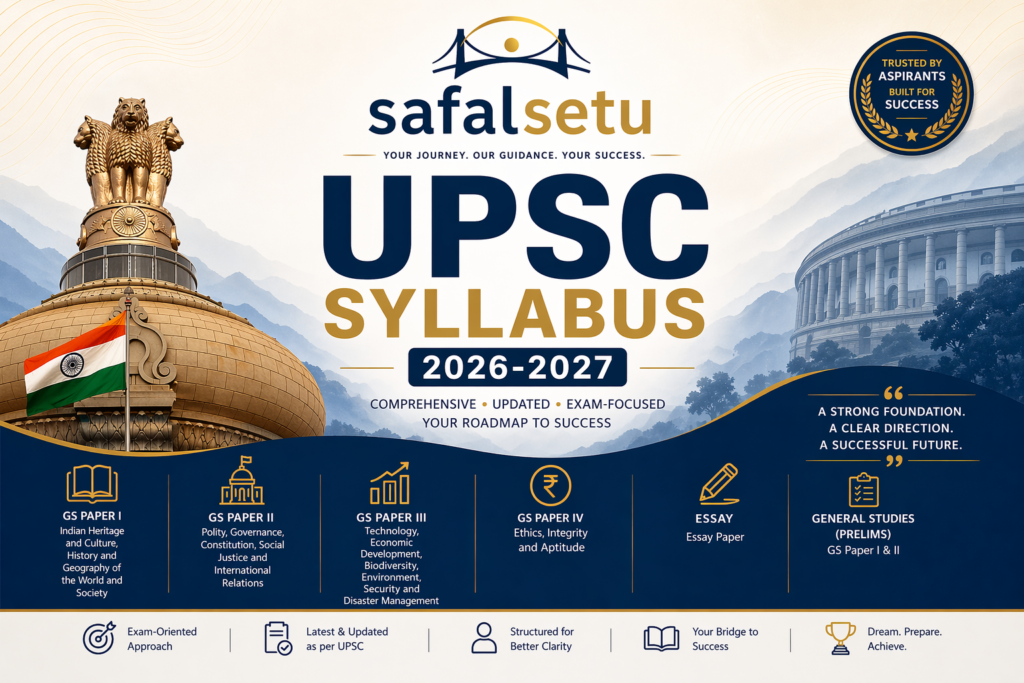
The UPSC Civil Services Examination (CSE) is often described as the toughest exam in the world, not just because of the competition, but because of the sheer vastness of its curriculum. For the 2026-2027 cycle, the syllabus remains a complex tapestry of traditional subjects and evolving contemporary issues. This guide serves as your definitive, long-form reference to every micro-topic and structural nuance you need to master.
Understanding the UPSC Exam Pattern for 2026-2027
Before diving into the subjects, one must grasp the three-stage architecture designed to test an aspirant’s depth, breadth, and personality.
Stage 1: The Preliminary Examination (Screening)
The Prelims consist of two objective-type papers. While Paper I (General Studies) determines your cutoff, Paper II (CSAT) is a qualifying hurdle where you must score at least 33%.
- GS Paper I: 100 Questions | 200 Marks | 2 Hours
- GS Paper II (CSAT): 80 Questions | 200 Marks | 2 Hours
Stage 2: The Mains Examination (Written)
The Mains is a descriptive test consisting of nine papers. Two are qualifying language papers, and the remaining seven determine your merit rank. Each merit paper carries 250 marks, totaling 1750.
Stage 3: The Personality Test (Interview)
This is the final 275-mark encounter with the UPSC board to assess your suitability for a career in public service.
UPSC Prelims Syllabus: GS Paper I Micro-Topics
This paper requires a “Jack of all trades” approach. You must know a little bit of everything under the sun, with a specific focus on Indian context.
History of India and Indian National Movement
In 2026-2027, the focus has shifted toward ancient administrative terms and the socio-economic impact of colonial rule.
- Ancient & Medieval: Indus Valley trade routes, Buddhist Sangha rules, Ashokan Edicts, Temple architecture (Nagara, Dravida, Vesara), Mughal land revenue (Zabt, Dahshala), and the Bhakti-Sufi synthesis.
- Modern History: The transition of power from the East India Company to the Crown, the role of extremist and moderate factions, and the specific contributions of unsung heroes in the freedom struggle.
Indian and World Geography
- Physical Geography: Plate tectonics, volcanism, and the specific mechanics of the Indian Monsoon (including IOD and Madden-Julian Oscillation).
- Human Geography: Global migration trends, demographic transition models, and the location of critical industries (Lithium, Semiconductors).
Indian Polity and Governance
- Constitutional Dimensions: Preamble, Fundamental Rights, DPSP, and the “Basic Structure” doctrine.
- Governance: The role of the CAG, Election Commission, and the increasing importance of Quasi-Judicial bodies like the NGT and NHRC.
Economic and Social Development
- Macroeconomics: Inflation (CPI vs. WPI), Monetary Policy (MPC functions), and Fiscal Policy.
- Social Sector: Sustainable Development Goals (SDGs), poverty indices, and flagship government schemes for financial inclusion.
UPSC Prelims Syllabus: GS Paper II (CSAT)
CSAT has become a “gatekeeper” in recent years due to its increasing difficulty in the Quant and Logical Reasoning sections.
- Reading Comprehension: Focus on critical reasoning, identifying assumptions, and drawing valid inferences from dense prose.
- Quantitative Aptitude: Number systems (divisibility, remainders), Permutation & Combination, Probability, and Data Interpretation (Bar charts, Pie diagrams).
- Logical Reasoning: Syllogisms, blood relations, seating arrangements, and analytical puzzles.
UPSC Mains Syllabus: Detailed GS Paper Breakdown
The Mains exam is where your “analytical muscle” is tested. You aren’t just stating facts; you are arguing perspectives.
GS Paper 1: Indian Heritage, Culture, History, and Geography of the World and Society
This paper links our past with the physical and social realities of the present.
- Indian Culture: Salient aspects of Art Forms, Literature, and Architecture from ancient to modern times.
- Modern Indian History: Significant events and personalities from the mid-18th century.
- Society: The diversity of India, the role of women and women’s organizations, urbanization problems, and the effects of globalization on Indian culture.
- Geography: Distribution of key natural resources across the world and important geophysical phenomena like earthquakes, Tsunami, and volcanic activity.
GS Paper 2: Governance, Constitution, Polity, Social Justice, and International Relations
This is perhaps the most dynamic paper, requiring daily updates from the news.
- Constitution: Comparison of the Indian constitutional scheme with that of other countries.
- Governance: Transparency and accountability, e-governance applications, and the role of civil services in a democracy.
- Social Justice: Issues relating to health, education, and human resources; poverty and hunger-related issues.
- International Relations: India and its neighborhood relations, bilateral and global groupings (Quad, BRICS, G20), and the effect of policies of developed countries on India’s interests.
GS Paper 3: Technology, Economic Development, Bio-diversity, Environment, Security, and Disaster Management
- Economy: Indian Economy and issues relating to planning, mobilization of resources, and inclusive growth.
- Agriculture: Major crops and cropping patterns, irrigation, and e-technology in the aid of farmers.
- Science & Tech: Developments and their applications in everyday life; Indigenization of technology (Space, Defense, AI).
- Environment & Security: Conservation, environmental pollution, and disaster management; Linkages between development and spread of extremism; Cyber security and money laundering.
GS Paper 4: Ethics, Integrity, and Aptitude
This paper tests your ethical framework and your ability to handle conflicting situations.
- Ethics & Human Interface: Essence, determinants, and consequences of ethics in human actions.
- Attitude: Content, structure, function, and its influence on thought and behavior.
- Emotional Intelligence: Concepts and their utilities in administration and governance.
- Case Studies: Applied ethics where you solve real-world administrative dilemmas.
The Importance of the Optional Subject
While the GS papers provide the foundation, the Optional Subject (divided into Paper I and Paper II) is often the “rank-maker.” Aspirants can choose from a list of 48 subjects, including Literature, Social Sciences, Engineering, and Medical Science. Choosing an optional should be based on your interest, educational background, and the availability of study material.
Conclusion
To clear the UPSC 2026-2027 cycle, one must move away from “Siloed Learning.” The modern UPSC question paper often merges Geography with Economics or Polity with Ethics. A “Micro-Syllabus” approach—breaking down these large headers into daily targets—is the only way to cover the 2025 marks total (1750 from Mains + 275 from Interview) effectively.