UPSC Prelims Syllabus 2026-27
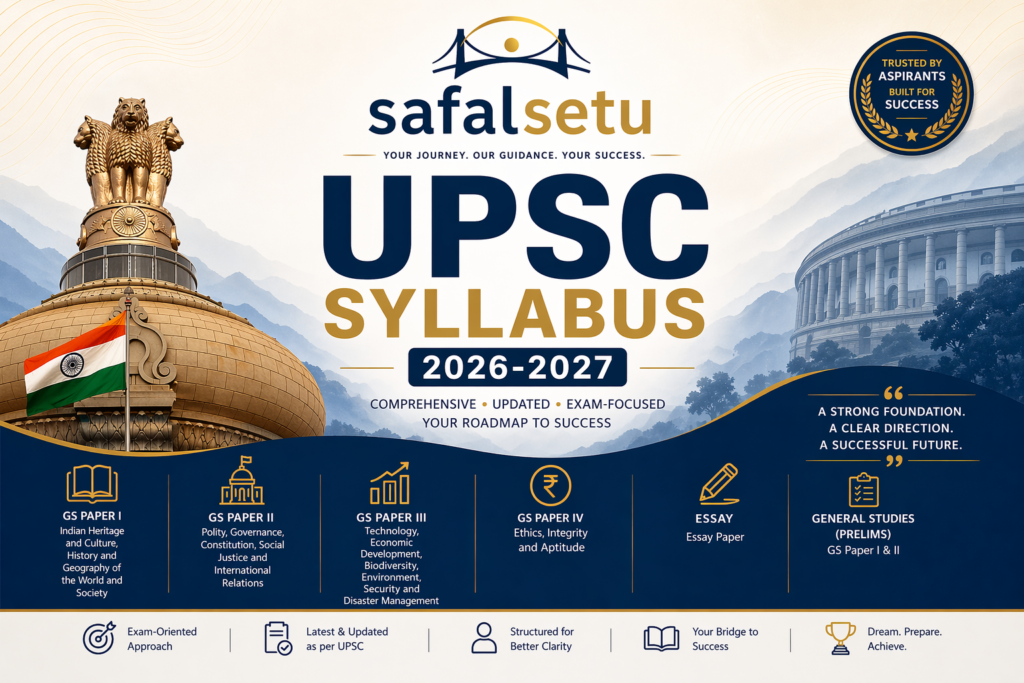
Are you planning to appear for the Civil Services Examination 2026-27? The UPSC journey begins with a single, often overwhelming step: decoding the syllabus.
Every year, lakhs of aspirants dive into preparation, but only those with a laser-focused “Roadmap” reach the interview stage. Whether you are looking for the UPSC Prelims syllabus or a detailed IAS Mains subject breakdown, this guide provides everything you need to stay ahead of the curve.
Why You Need a Strategy-First UPSC Syllabus Breakdown
The official UPSC notification is often a dense document. To succeed, you need a Micro-Syllabus—a way to break down broad topics like “History” or “Economy” into actionable themes.
1. General Studies Paper – I: The Merit Pillar
This paper is the deciding factor for your selection to the next stage. It tests your breadth of knowledge across multiple disciplines.
Current Affairs: The Dynamic Core
- National Significance: Major government schemes, judicial rulings, and legislative changes.
- International Significance: Bilateral treaties, global indices, and geopolitical conflicts (e.g., BRICS+, G20 updates).
History: From Origins to Independence
- Ancient & Medieval: Focus on art, architecture, and administrative systems of empires like the Mauryas, Guptas, and Mughals.
- Modern Indian History: The struggle for independence, key personalities, and the evolution of the Indian National Movement from the mid-18th century to 1947.
Geography: Mapping the World
- Physical: Geomorphology, climatology, and oceanography.
- Human & Economic: Population trends, resource distribution, and industrial locations in India and across the globe.
Polity & Governance: The Rule of Law
- The Constitution: Preamble, Fundamental Rights, and Directive Principles.
- Political System: The functioning of the Parliament, Judiciary, and Panchayati Raj institutions.
Economy: Planning for Growth
- Fundamental Notions: Inflation, GDP, Banking (RBI), and Fiscal Policy.
- Government Initiatives: Social sector programs, poverty alleviation, and sustainable development goals.
Environment & Science
- Ecology: Biodiversity hotspots, climate change protocols, and environmental legislation.
- Science & Tech: Recent advancements in Space (ISRO), Biotechnology, and Artificial Intelligence.
2. General Studies Paper – II: CSAT (Qualifying Pillar)
While the CSAT is qualifying (requiring a minimum of 33% or 66 marks), its increasing difficulty makes it a critical hurdle for many aspirants.
Comprehension Skills
- This section tests your ability to extract the essence of a passage and identify logical assumptions or conclusions. Success here depends on regular reading of editorials.
Logical Reasoning & Analytical Ability
- Focuses on puzzles, syllogisms, blood relations, and seating arrangements. It assesses your capacity for deductive and critical thinking.
Quantitative Aptitude & Data Interpretation
- Basic Numeracy: Numbers and their relations, orders of magnitude, and Class X level mathematics.
- Data Interpretation: Charts, graphs, and tables.
3. Preparation Strategy for 2026-2027
To tackle this syllabus effectively, prioritize the Static-Dynamic Link. For instance, if a constitutional article is mentioned in the news, revisit its historical origins and legal implications.
- GS Paper I Strategy: Focus on high-weightage areas like Polity and Environment early in your preparation.
- CSAT Strategy: Don’t leave it for the last month. Dedicate weekly sessions to practice basic numeracy and logical reasoning to ensure you cross the 33% threshold comfortably.
Pro Tip: For the 2026-27 attempt, focus heavily on Mapping and Environmental Legislation, as these areas have seen a 20% spike in question density recently.
Frequently Asked Questions (FAQs)
Q1: Has the UPSC Syllabus changed for 2026?
No, the core subjects remain the same. However, the nature of questions is shifting toward “Applied Knowledge” rather than rote memorization.
Q2: Is CSAT still qualifying in 2026?
Yes, you need to score a minimum of 33% (approx. 66 marks) in GS Paper II to have your GS Paper I evaluated.
Q3: How many months of Current Affairs are needed for 2026-27?
Ideally, cover 18 months of current events leading up to the Prelims 2026 date.
Ready to start? The first step is to print the syllabus and paste it on your study wall. Consistency is your best friend in this journey!