India Rising: The Journey to Self-Reliance
Preface
As India celebrates its 79th Independence Day, the country’s manufacturing sector has emerged as a strong symbol of self-reliance and economic growth. Over the past decade, major reforms and forward-looking policies under the Make in India initiative have helped transform India into a global manufacturing hub.
Today, industries ranging from defence production, electronics, pharmaceuticals, to advanced medical devices are producing high-quality, world-class products for both domestic use and international markets. This shift has strengthened India’s position in global supply chains.
To boost this progress further, the government introduced the National Manufacturing Mission in the Union Budget 2025–26. With an investment of around ₹1 billion, this mission aims to promote innovation, improve competitiveness, and increase efficiency in key industries.
This rapid growth highlights India’s commitment to:
- Reducing import dependence
- Creating employment opportunities
- Enhancing global competitiveness
Driven by innovation, investment, and entrepreneurship, India is steadily moving towards becoming a self-reliant (Atmanirbhar) nation and a major player in the global economy.
India’s footprint in manufacturing
The manufacturing sector in India continues to be a key driver of the country’s economic growth and development. Over the past decade, this sector has grown steadily, contributing a larger share to India’s GDP (Gross Domestic Product) and creating stable employment opportunities for millions of people.
There has also been a noticeable increase in manufacturing value addition, which means industries are producing more finished and high-quality goods rather than just raw materials. This growth reflects improved productivity, better technology adoption, and increased investment in infrastructure and production capacity.
| Indicator | 2013–14 | 2023–24 |
|---|---|---|
| Share of Manufacturing in Total GVA (%) | 17.2% | 17.5% |
| Manufacturing GVA (₹ lakh crore, constant prices) | 15.60 | 28.25 |
Production-Linked Incentive (PLI) Scheme
The Production Linked Incentive Scheme is one of India’s most important initiatives to boost domestic manufacturing and industrial growth. With a total budget of ₹1.97 lakh crore (over $26 billion), the scheme covers 14 key sectors such as electronics, IT hardware, pharmaceuticals, bulk drugs, medical devices, telecom, food processing, white goods, automobiles, specialty steel, textiles, and drones.
The main aim of the PLI scheme is to:
- Increase local manufacturing in India
- Encourage technology adoption and innovation
- Strengthen India’s role in global supply chains
Key Highlights of the PLI Scheme
- About ₹21,534 crore in incentives has already been distributed across sectors
- Around ₹1.76 lakh crore investment has been made up to March 2025
- Total production and sales have crossed ₹16.5 lakh crore
- The scheme has created over 12 lakh jobs (direct and indirect)
Defence Manufacturing – From Importer to Exporter
Over the past decade, India’s defence manufacturing sector has seen a major transformation. With strong government policies, increased investments, and a clear focus on self-reliance (Atmanirbhar Bharat), India is no longer just a buyer of defence equipment—it is now becoming a leading producer and exporter.
The country has moved from depending heavily on imports to developing and manufacturing advanced defence technologies within India. This shift is a big step towards strengthening national security and economic independence.
Key Highlights of India’s Defence Sector Growth
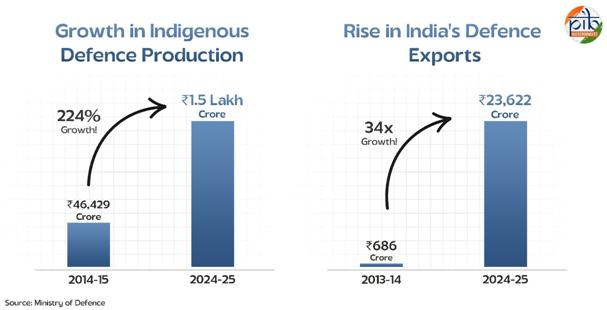
- The value of indigenous defence production is expected to reach ₹1,50,590 crore in FY 2024–25
- Up by 18% from last year
- Over 3 times higher than 2014–15 levels
- Defence exports have grown rapidly:
- From ₹686 crore (2013–14) to ₹23,622 crore (2024–25)
- This is a 34-fold increase
- The government has introduced five Positive Indigenisation Lists, covering 5,500+ defence items
- Around 3,000 items have already been made in India (as of Feb 2025)
Made-in-India Defence Equipment
India is now producing advanced systems such as:
- HAL Tejas (fighter jet)
- Arjun MBT
- Artillery guns, assault rifles, and radars
- Warships, sonar systems, and transport aircraft
- Light combat helicopters, rockets, bombs, and armoured vehicles
Growing Defence Exports
India’s defence exports now include:
- Bulletproof jackets
- Dornier Do 228 aircraft
- HAL Chetak helicopters
- Fast interceptor boats and lightweight torpedoes
India exports defence products to 100+ countries, with major buyers including:
- United States
- France
- Armenia
What this means
India’s defence sector is becoming a strong pillar of economic growth and national security. By producing its own defence equipment and increasing exports, the country is:
- Reducing import dependence
- Creating jobs and innovation opportunities
- Strengthening its position in the global defence market
Electronics and Mobile Manufacturing
India has quickly grown into a major center for electronics manufacturing. With strong government support through initiatives like Make in India and Atmanirbhar Bharat, the country has made impressive progress in both production and exports.
One of the biggest success stories is mobile phone manufacturing. Earlier, India depended heavily on imports, but now it has become one of the largest producers of mobile phones in the world. Many global and Indian companies are manufacturing devices within the country, creating jobs and boosting the economy.
| Indicator | 2014–15 | 2024–25 | Growth |
|---|---|---|---|
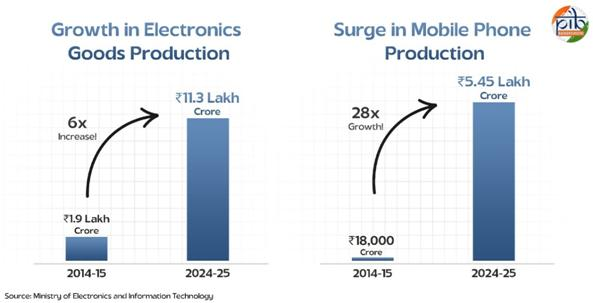
| Production of Electronic Goods | ₹1.9 lakh crore | ₹11.3 lakh crore | ~6 times |
| Export of Electronic Goods | ₹38,000 crore | ₹3.27 lakh crore | 8 times |
| Mobile Manufacturing Units | 2 | 300 | 150 times |
| Mobile Phone Production | ₹18,000 crore | ₹5.45 lakh crore | 28 times |
| Mobile Phone Export | ₹1,500 crore | ₹2 lakh crore | 127 times |
Pharma and Medical Manufacturing
India has become a major player in the global pharmaceutical industry. It ranks third in the world by volume and fourteenth by value, which means India produces a large quantity of medicines at affordable prices. The country supplies around 20% of the world’s generic medicines and a large share of vaccines, helping ensure affordable healthcare across the world.
Over the years, steady growth in production, exports, and innovation has made India a trusted global supplier of medicines.
Key Highlights
- The pharmaceutical sector’s total turnover is expected to reach ₹4,17,345 crore in 2023–24, with over 10% annual growth in the last five years
- Under the Production Linked Incentive Scheme, total sales in the first three years reached ₹2.66 lakh crore, including ₹1.70 lakh crore from exports
- India has shifted from being a net importer of bulk drugs (loss of ₹1,930 crore earlier) to becoming a net exporter worth ₹2,280 crore in 2021–22
- Through the PLI scheme for medical devices, 21 projects have started producing 54 types of advanced equipment, such as:
- MRI machines
- CT scanners
- Heart valves and stents
- Dialysis machines
What this means
India’s pharmaceutical sector is not only growing fast but also playing a crucial role in making healthcare affordable worldwide. By increasing domestic production and exports, India is strengthening its position as the “pharmacy of the world” and moving closer to becoming a self-reliant healthcare hub.
Foreign Direct Investment (FDI) in Manufacturing
India has become one of the most attractive destinations for global investors. Over the past decade, the government has introduced continuous reforms, made rules simpler, and created a stable business environment. This has encouraged companies from around the world to invest in India’s manufacturing sector.
Efforts to improve the ease of doing business and provide sector-specific incentives have made India a strong and competitive manufacturing hub.
Key Highlights
- Between April 2014 and March 2025, India’s manufacturing sector received $184.15 billion in foreign direct investment (FDI)
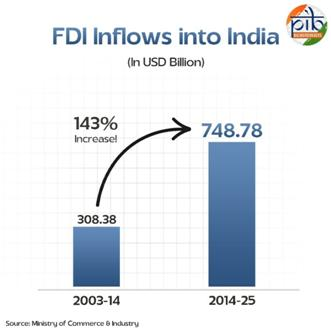
- Total FDI inflows in India during 2014–25 reached $748.78 billion, which is 143% higher than the $308.38 billion received between 2003–14
- About 70% of total FDI in the last 25 years came in the period 2014–25, showing a major rise in investor confidence
- Annual FDI inflows increased from $36.05 billion in 2013–14 to around $81.04 billion in 2024–25, reflecting strong growth
- The government now aims to increase annual FDI inflows to $100 billion, compared to the current average of about $70 billion.
Conclusion
India’s journey over the past decade shows a strong move towards becoming a self-reliant and globally competitive nation. From manufacturing and defence to electronics, pharmaceuticals, and foreign investment, every sector is growing steadily and contributing to the country’s development.
Government initiatives like Make in India and Production Linked Incentive Scheme have played a major role in boosting production, creating jobs, and attracting global investors. As a result, India is not only meeting its own needs but also supplying high-quality products to the world.
Overall, this progress reflects India’s strong commitment to innovation, economic growth, and self-reliance, helping it emerge as a powerful player in the global economy.