India Emerges as Cradle of Jamun Evolution
Source: PIB
The discovery that India served as the primary evolutionary cradle for the Jamun (Syzygium) genus rewrites the botanical history of the subcontinent, shifting the center of origin from Australia to the ancient landmasses of India and East Gondwana.
Summary
- Ancient Roots: The Jamun genus (Syzygium) originated approximately 80 million years ago during the Late Cretaceous period in East Gondwana.
- India as a Cradle: Fossil evidence confirms that India was the central hub for the early diversification of the genus, rather than Australia as previously thought.
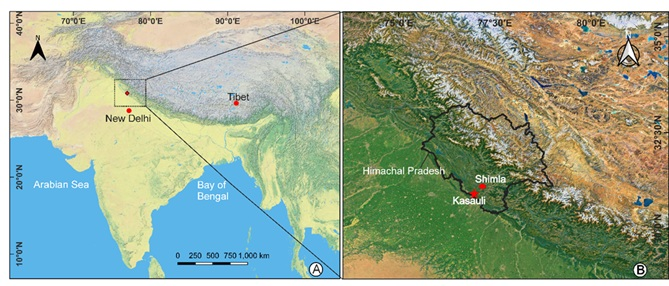
- The Kasauli Fossil: The discovery of Syzygium paleosalicifolium (fossil leaves) in the Kasauli Formation of Himachal Pradesh provides a 20-million-year-old link to modern Jamun species.
- Resilience: The genus has maintained a continuous presence in India for over 55 million years, surviving massive climatic shifts between the Paleogene and Neogene periods.
- Scientific Method: Researchers used Venation Architecture (the intricate patterns of leaf veins) to identify and classify these ancient specimens.
Background Concept
To understand how Jamun “originated” in India, one must look at the movement of the Indian plate after the breakup of the supercontinent Gondwana.
1. East Gondwana and the Indian Plate
About 180 million years ago, the supercontinent Gondwana began to break apart. India, Madagascar, Australia, and Antarctica formed “East Gondwana.” As India broke away and moved northward toward Asia, it carried a “biological cargo” of ancient plants, including the ancestors of the Jamun.
2. The “Out-of-India” Hypothesis
This study supports the “Out-of-India” theory, which suggests that many tropical plant groups evolved on the Indian plate while it was an isolated island continent. Once India collided with Asia (~50 million years ago), these plants spread across the rest of the world.
3. Venation Architecture as a “Fingerprint”
Plants are often identified by their flowers, but flowers rarely fossilize. Instead, scientists use Venation Architecture—the arrangement of veins in a leaf.
- Syzygium leaves have unique secondary veins and marginal veins that act like a botanical fingerprint. By comparing the vein patterns of 20-million-year-old fossils with modern Jamun leaves, scientists could confirm they belonged to the same family.
Key Features of the Discovery
| Feature | Details |
| Fossil Name | Syzygium paleosalicifolium |
| Location | Kasauli Formation, Himachal Pradesh |
| Age of Fossil | ~20 Million Years (Early Miocene) |
| Historical Range | Continuous presence in India since the Early Eocene (~55 mya) |
| Key Traits | Intricate venation, high adaptability to climatic shifts |
Multiple Choice Questions (MCQs)
Q1. According to recent research, approximately how many million years ago did the Jamun (Syzygium) genus originate?
A) 20 million years
B) 55 million years
C) 80 million years
D) 180 million years
Q2. The “Kasauli Breakthrough” involved the discovery of 11 well-preserved fossil leaves in which Indian state?
A) Kerala
B) Himachal Pradesh
C) Assam
D) Gujarat
Q3. Previously, the Jamun genus was theorized to have originated in which country/continent?
A) Africa
B) South America
C) Australia
D) Antarctica
Q4. What is “Venation Architecture” primarily used for by paleobotanists?
A) Measuring the height of a tree.
B) Analyzing the arrangement of veins in leaves to identify plant species.
C) Determining the sugar content of the fruit.
D) Calculating the speed of continental drift.
Q5. In which ancient landmass did the Jamun genus first appear during the Late Cretaceous period?
A) Laurasia
B) East Gondwana
C) Tethys Ocean
D) Pangea
Answers:
Q1: C | Q2: B | Q3: C | Q4: B | Q5: B