A Decade of AMRUT: Strengthening Urban Infrastructure and Services
Introduction
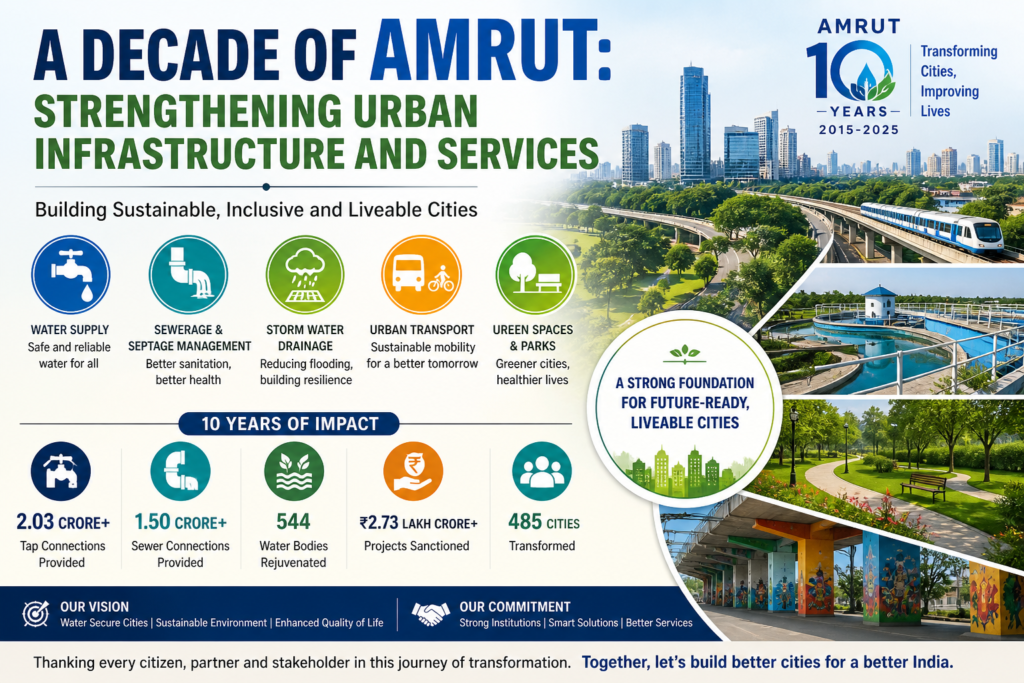
India is celebrating 10 years of the Atal Mission for Rejuvenation and Urban Transformation (AMRUT), an important government initiative aimed at improving the quality of life in urban areas. Launched on 25 June 2015, this mission focuses on providing essential urban services such as clean water supply, proper sewerage systems, better urban transport, and green public spaces like parks.
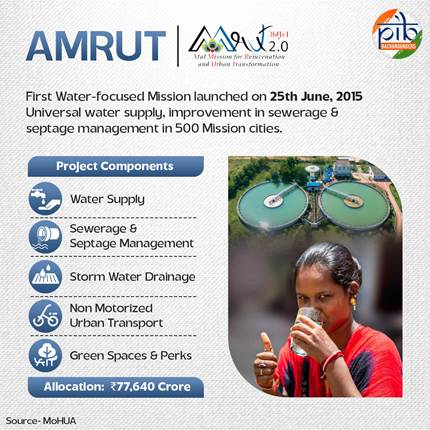
The main goal of AMRUT is to build strong urban infrastructure that delivers better services to people, especially those from economically weaker sections. Special importance has been given to water supply and sewerage systems, ensuring that cities become healthier and more livable. Additionally, up to 2.5% of project funds are allocated for developing parks with facilities for children and elderly citizens, promoting community well-being.
The mission initially covered 500 cities and towns (now 485 cities, including merged ones) and operates as a centrally sponsored scheme, where funding is shared between the central government and states based on urban population and number of towns.
Under AMRUT, State Annual Action Plans (SAAPs) worth ₹77,640 crore have been approved, including ₹35,990 crore as central assistance. So far, projects worth ₹79,401 crore have been completed, with a total expenditure of ₹72,656 crore, showing strong progress in urban development.
Key Objectives of AMRUT
- Ensure every household has access to tap water with a reliable supply and proper sewerage connections
- Improve the livability of cities by developing greenery, parks, and open spaces
- Reduce pollution by promoting public transport and non-motorized transport such as walking and cycling
Overall, AMRUT has played a crucial role in urban transformation in India, helping cities become more sustainable, inclusive, and better equipped to meet the needs of growing populations.
Benefits and Key Components
Over the last 10 years, AMRUT has played a major role in improving urban infrastructure in India. The mission focuses on multiple areas such as water supply, sewerage systems, drainage, urban transport, green spaces, and capacity building. Urban Local Bodies (ULBs) have also started using smart technologies to make services more efficient and citizen-friendly.
Water Supply Improvements
AMRUT has strengthened access to clean and safe drinking water by:
- Expanding and upgrading existing water supply systems
- Setting up modern water treatment plants
- Introducing universal water metering for better monitoring
- Repairing and modernizing old infrastructure
- Rejuvenating water bodies to improve groundwater recharge
- Providing special solutions for difficult areas like hilly, coastal, and water-contaminated regions (arsenic, fluoride issues)
Sewerage and Wastewater Management
The mission has improved sanitation and hygiene in cities by:
- Building modern underground sewerage networks
- Expanding sewage treatment plants
- Upgrading old sewer systems
- Promoting wastewater recycling and reuse, helping conserve water resources
Septage Management
AMRUT has introduced better systems for handling waste from septic tanks:
- Efficient faecal sludge management (FSM) including collection, transport, and treatment
- Use of mechanical and biological cleaning methods
- Focus on cost-effective operations and recovery of maintenance costs
Storm Water Drainage
To reduce urban flooding, the mission focuses on:
- Building and improving storm water drains
- Strengthening drainage systems to prevent waterlogging during heavy rains
Urban Transport Development
AMRUT promotes sustainable and efficient urban transport by:
- Introducing buses and ferry services for inland waterways
- Developing footpaths, walkways, and cycling tracks
- Building foot over-bridges and multi-level parking systems
- Supporting systems like Bus Rapid Transit System (BRTS)
Green Spaces and Parks
To improve quality of life, the mission encourages:
- Development of parks and green spaces
- Creating child-friendly and elderly-friendly recreational areas
- Enhancing the environmental and social value of cities
Capacity Building and Institutional Strengthening
AMRUT also focuses on improving governance and skills:
- Training individuals and strengthening institutions in Urban Local Bodies
- Extending capacity-building programs beyond mission cities
- Continuing initiatives like the Comprehensive Capacity Building Programme (CCBP) to improve urban management
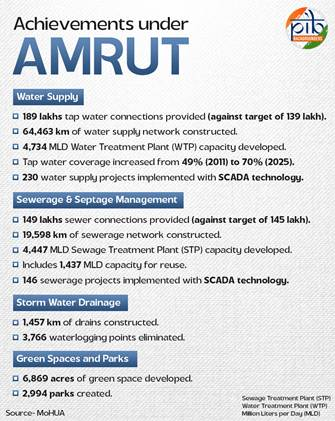
Key Achievements
AMRUT 2.0: Making Indian Cities Water-Secure
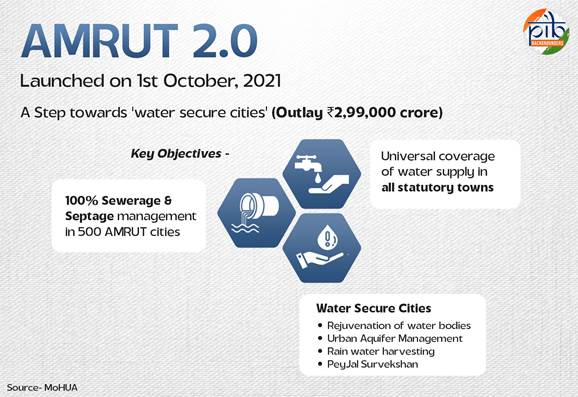
AMRUT 2.0, launched on 1 October 2021, is the next phase of the Atal Mission for Rejuvenation and Urban Transformation. It aims to make Indian cities water-secure, sustainable, and self-reliant by expanding essential urban services to all Urban Local Bodies (ULBs).
The mission focuses on providing universal water supply, sewerage, and septage management, especially in the original 500 AMRUT cities. The total planned investment is around ₹2.99 lakh crore, including a central share of ₹76,760 crore over five years, making it one of India’s largest urban development programs.
“Jal Hi AMRIT” Initiative
Under AMRUT 2.0, the Ministry of Housing and Urban Affairs launched the “Jal Hi AMRIT” initiative. This program encourages states and UTs to:
- Improve the efficiency of sewage treatment plants (STPs)
- Promote safe treatment and reuse of wastewater
- Strengthen water conservation and water security in cities
Key Achievements under AMRUT 2.0
1. Water Supply Expansion
- 3,568 water supply projects approved worth ₹1.14 lakh crore
- 181 lakh (18.1 million) new tap connections sanctioned
- 10,647 MLD water treatment capacity approved
- 1,487 projects using SCADA technology for smart monitoring
2. Sewerage & Septage Management
- 592 projects approved worth ₹67,607 crore (including operation & maintenance)
- 67.11 lakh new sewer connections approved
- 6,739 MLD sewage treatment capacity created
- 235 projects using SCADA technology for efficient management
3. Innovation & Start-up Support
- Launch of Technology Sub-Mission to promote innovation
- 120 start-ups shortlisted
- Pilot projects implemented in 82 AMRUT cities to encourage smart urban solutions
Overall Achievements
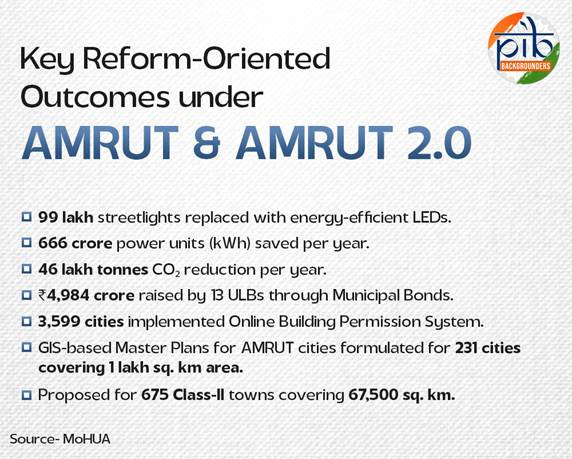
Physical Progress
- 14,828 projects worth ₹2.73 lakh crore sanctioned
- Projects worth ₹1.12 lakh crore completed
Financial Progress
- ₹3.77 lakh crore total outlay
- ₹1.02 lakh crore central assistance allocated
- ₹97,963 crore spent by Centre, States, and ULBs
- ₹47,625 crore released as central funds
Major Outcomes
- 2.03 crore tap water connections provided
- 1.50 crore sewer connections created
- 544 water bodies rejuvenated, covering 9,511 acres
Other Initiatives
- ‘AMRUT Mitra’ involved 10,000+ women Self-Help Group (SHG) members.1,762 projects worth ₹147 crore approved.
- Drink from Tap (DFT) through 381 projects worth ₹23,490 crore sanctioned, likely to benefit 8 lakh households.3,630 contractors/officials trained.
- 3,032 water bodies approved for rejuvenation, covering 1.09 lakh acre area.
- Capacities of States augmented by training over 90,000 contractors, plant operators, plumbers, women, youth, officials etc.
Conclusion
As AMRUT completes 10 years, it shows how India’s approach to urban development has changed for the better. The focus is now on including everyone, providing better services, and promoting sustainable growth. By improving basic facilities like water supply, sanitation, and green spaces, and by strengthening local city bodies, the Atal Mission for Rejuvenation and Urban Transformation has built a strong base for cities that are more livable, modern, and ready for the future.